

Search Engine Optimization (SEO) has been a mainstay in the digital marketing world since the late 1990’s. Since then, search engines have evolved consistently and so has the way we approach SEO.
The latest evolution in information retrieval has been heavily influenced by — you guessed it — Artificial Intelligence (AI). New tools such as Google Search Generative Experience (SGE), ChatGPT, Claude, Bard, Meta AI Search, and plenty of others are quickly changing the way people search for information online.
The influence of AI on search engines has been so intense that it’s birthed an entirely new discipline: Generative Engine Optimization (GEO).
Naturally, the SEO world is in a frenzy. But when is it not? Let’s dig into what GEO is and what it means for businesses.
What Is Generative Engine Optimization (GEO)?
The term Generative Engine Optimization (GEO) first appeared in a 2023 study on how to increase visibility in AI search results.
Basically, people are thinking there is a way to optimize against LLM-based search engines like Bard, Google SGE, and ChatGPT. Since these tools work differently than traditional search engines, and since more and more people are starting to use them, it’s a thought that’s worth considering.
How Does GEO Work?
Generative search is still new but its impact is being felt by businesses and marketing departments everywhere. Just look around and you’ll see all kinds of reports that organic traffic is dropping and top-ranked websites are getting fewer clicks.
Naturally, we’re all scrambling to figure out what this means and adapt accordingly. But before we can understand how GEO works, we need to understand what makes generative search engines different from traditional search engines.
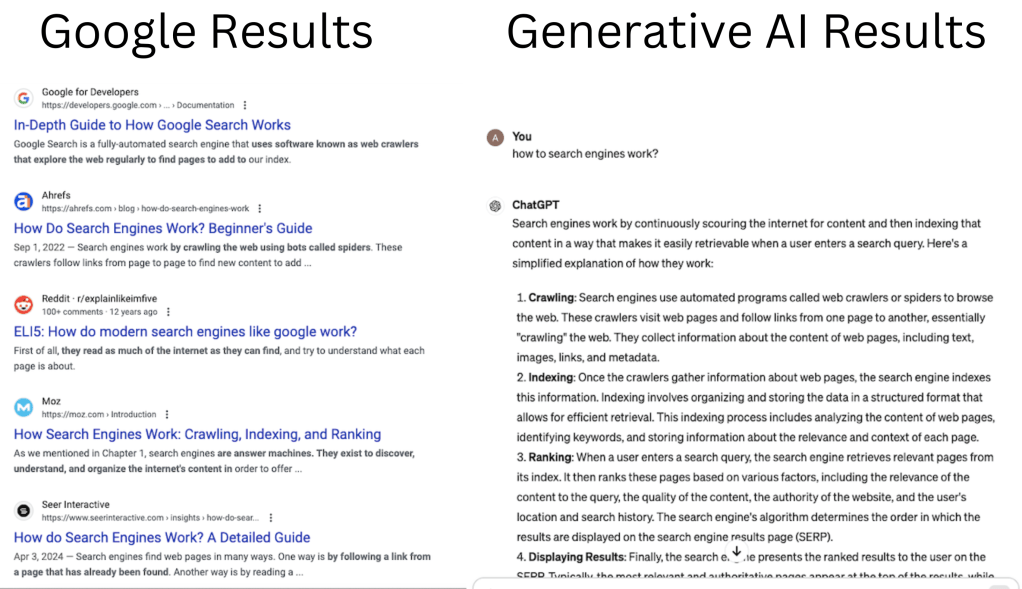
Generative search vs. traditional search
Generative search is still in its infancy so it’s hard to know exactly how it will evolve in the coming years. But the foundation has been laid and it’s clear that there are some important differences between generative search engines and traditional search engines.
Traditional searches, such as Google and Bing…
- Use keywords and search terms to fetch information and display websites
- Use ranking signals like page speed and mobile friendliness to organize results
Generative search engines…
- Go beyond information retrieval to provide original, comprehensive responses by combining information from multiple sources
- Use machine learning to generate content that is contextually relevant
GEO vs. SEO
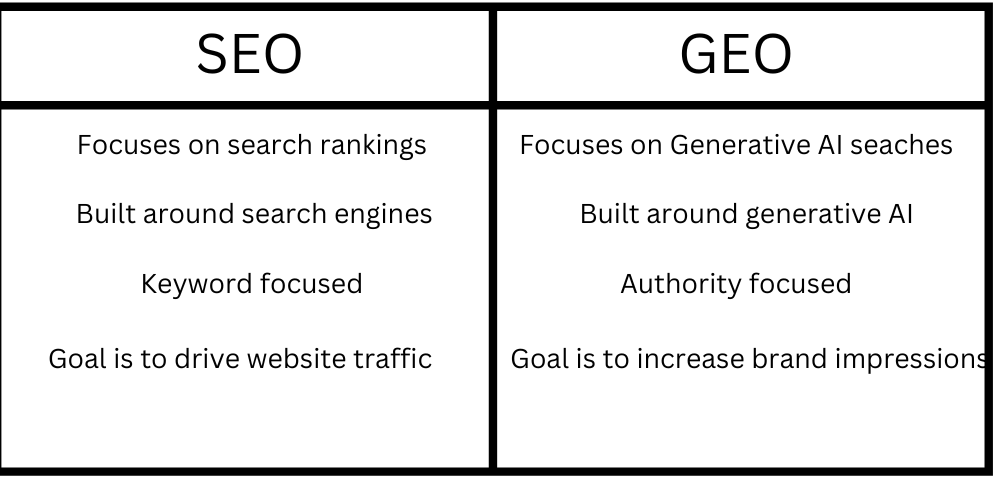
While GEO and SEO serve similar purposes — to help businesses gain revenue through online searches — there are several differences between these two tactics.
SEO is a tactic that helps websites gain visibility in traditional search engines that assign a ranking based on how relevant a page is to the search query.
GEO helps to build authority by increasing brand mentions in AI-driven search results that generate comprehensive responses.
To make it simple, here are some key differences between the two:
SEO
- Goal is to make websites rank higher in search engine results pages (SERPs).
- Is built around how search engines like Google and Bing crawl and index websites.
- Relies heavily on keywords and on-page optimizations.
- Uses targeted keywords, high-quality content, and link acquisition to improve visibility.
- Uses KPIs such as click-through rate, bounce rate, and time spent on page to measure success.
GEO
- Goal is to increase brand mentions in generative AI responses
- Is built around how generative AI tools like Google SGE, ChatGPT, and Claude formulate responses
- Relies on citations, SME quotations, and statistics to increase relevance.
- Uses authoritative language, original research, and citation optimization to improve visibility
- Uses KPIs centered around impression metrics to measure success
GEO Best Practices
Although generative search is still new and will most definitely evolve and the tech improves and adoption becomes more widespread, there are still some best practices we can start to incorporate into our content strategies.
- Authoritative content – Use authoritative and persuasive language to make claims with confidence.
- Keyword placement – Include common search terms and phrases into your content.
- Data-driven arguments – Use quantitative data to back up your claims.
- Citation usage – Provide attribution by citing relevant sources throughout your content.
- Include quotations – Interview Subject Matter Experts and use quotations to build authority and add depth to your content.
- Structure – Design your content so that its structure is easy to understand by readers and generative engines.
- Readability – Use high-quality writers to ensure a smooth and coherent reading experience.
- Original writing – Avoid cliches and use engaging word choices to make your content stand out.
- Domain expertise – Incorporate technical terms and some industry jargon to give the appearance of professionalism. But don’t overdo it. (see: structure and readability)
If you’re thinking this sounds alot like SEO, you’re right. There are a lot of similarities. But the biggest difference right now is the emphasis on original research and citation usage. Plus, as I said earlier, GEO will evolve over time and so will these best practices.
When to Use GEO
Is GEO the new SEO? Sort of. Generative AI probably won’t replace search engines any time soon, so I don’t recommend abandoning one tactic for the other. For now, It’s best to take a complimentary approach and use both side by side.
Here’s My Take
Is Generative AI really the future of information retrieval? Will GEO replace SEO completely?
Only time will tell. I don’t think GEO will fully replace SEO anytime soon, but businesses need to get ahead of the curve and implement some of the best practices mentioned above.
But either way, I hope it gets a name change. GEO makes me think about rocks and it doesn’t sound as cool as SEO.
 SEOstateof_mind